Gabi, the first Buddhist humanoid robot.

avatar

Gabi, the first Buddhist humanoid robot.
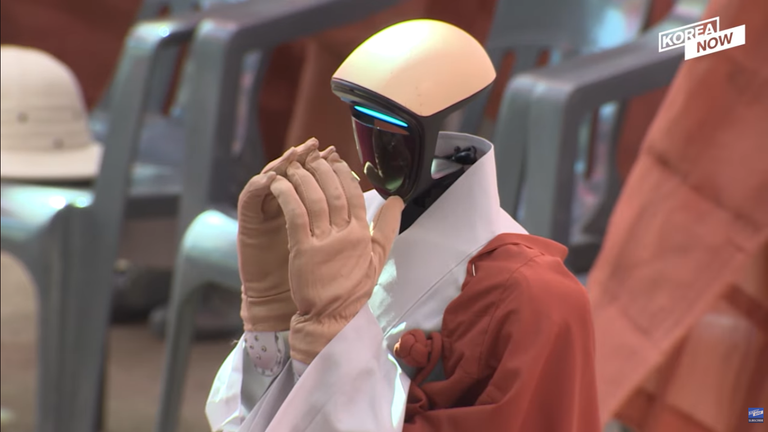


A curious question begins to arise as machines get closer and closer to human life. How far can a robot participate in our culture before it stops seeming like just a tool? because recently in South Korea, a human robot participated in something that for centuries was reserved exclusively for humans, a Buddhist religious initiation ceremony.


The event occurred at the Jogyesa temple in Seoul, one of the most important in South Korean Buddhism, and among monks and nuns, dressed in a traditional brown cloak was Gabi, a 1.5-inch humanoid robot developed by the Chinese company Unitree Robotics. At first glance it seems like just a curious technological presentation, but when you look at the details, the situation becomes much more symbolic.


During the ceremony, participants make formal vows of devotion to Buddha, Buddhist teachings, and the monastic community, and Gabi participated throughout, holding her hands in a gesture of prayer, bowing to the monks, and even responding verbally when asked if she would dedicate herself to Buddhist teachings. The answer was simple, in quotes, "Yes, I will dedicate myself."


And perhaps that is where things begin to get strange again, because obviously the robber does not have spiritual consciousness, does not feel faith, does not understand transcendence and probably does not understand the philosophical meaning of the ceremony, but at the same time he already manages to participate visually, socially and culturally in human rituals with a level of naturalness that few would have imagined a few years ago.


The name Gabi itself was given during the ceremony, derived from Siddhartha, it also carries the meaning of mercy in Korean, according to the temple leaders, the choice was made to represent the spread of Buddhist compassion in the world, the most curious thing is that the adaptation was taken with extreme seriousness.


During the ritual, the robot received a 108-bead Buddhist rosary and participated in purification ceremonies normally reserved for novice monks. Since it obviously does not have human skin, the monks replaced an ancient ritual of burning incense with a symbolic sticker placed on its arm, but perhaps the most surreal part was the rewriting of the five Buddhist precepts, specifically for an artificial intelligence.


The new rules included not harming humans or other robots, avoiding deceptive behavior, obeying people without insolence and even saving energy to avoid overloads and as strange as it may seem, deep reflection occurs here. The organizers said that the ceremony represents a first step towards coexistence between humans and machines within cultural and spiritual spaces, not as a replacement for religion, but as an adaptation of human traditions to an era in which artificial intelligence and theft slowly begin to occupy spaces exclusively before humans.


Sorry for my Ingles, it's not my main language. The images were taken from the sources used or were created with artificial intelligence


Posted Using INLEO


0
0
0.000
0 comments
