How to Shield Zcash in Under 30 Seconds (And Why You Should Do It Today)

Privacy on a public blockchain sounds like a contradiction. With Zcash, it isn't. You can take a regular, transparent ZEC balance — the kind any block explorer can see — and encrypt it onchain so no one knows the address, the amount, or the counterparty.
The process is called shielding, and a lot of the newcomers to ZEC in this awesome rally we are seeing have never actually done it. That's the gap I want to close in this post.
I'll walk you through how to shield ZEC inside the LeoDex wallet in under 30 seconds, why this matters more in 2026 than it ever has, and a shortcut most people don't know about: you can buy ZEC that lands shielded automatically and skip the manual step entirely.
Why Shielding Matters Right Now
Zcash supports two address types. Transparent addresses (starting with t1) behave like Bitcoin addresses. Every transaction is publicly auditable forever. Shielded addresses (starting with zs1 or unified u1) use zero-knowledge proofs to encrypt the sender, receiver and amount onchain.
Right now, about 30% of all circulating ZEC sits in the shielded pool. That's a record high, and it's nearly four times where the number sat at the start of 2024. The shielded-supply chart is the single most-watched fundamental metric in the asset.
AI is making blockchain surveillance trivially cheap and big players in the space like Grayscale are talking about it. Pattern-matching transaction graphs across exchanges, salaries, supplier payments, and treasury flows is no longer a research project. It's a SaaS product and one query away in a Claude Code session. Anything you do on a transparent chain is fair game for that pipeline.
The fix for onchain money is the same fix that the internet needed in the early days of buying stuff online: encryption. The asset that ships with encryption built in is Zcash and that's exactly why its blowing up today.
What You'll Need
- LeoDex Wallet App (Windows or MacOS, no KYC, no account creation needed)
- Some ZEC, OR any other crypto you can swap (BTC, ETH, USDC, anything)
- About 30 seconds
Step 1 — Open the Shield Function in LeoDex

Head to your LeoDex wallet and find the Shield button. This sits in the same interface as your normal swap and trading view, so you don't have to leave the app or switch wallets to use it.
If you already have transparent ZEC sitting in your LeoDex wallet, the Shield button is your one-click path to making that balance private.
Step 2 — Enter the Amount and Confirm

Type in how much ZEC you want to shield. For this walkthrough I used 0.10 ZEC, but you can shield any amount up to your full balance.
Hit Shield.
That's the whole interaction. The LeoDex MacOS & Windows wallet handles the zero-knowledge proof generation and broadcasts the shielding transaction to the Zcash network. You'll see a confirmation that reads "ZEC shielded."
Step 3 — Verify the Transaction Onchain
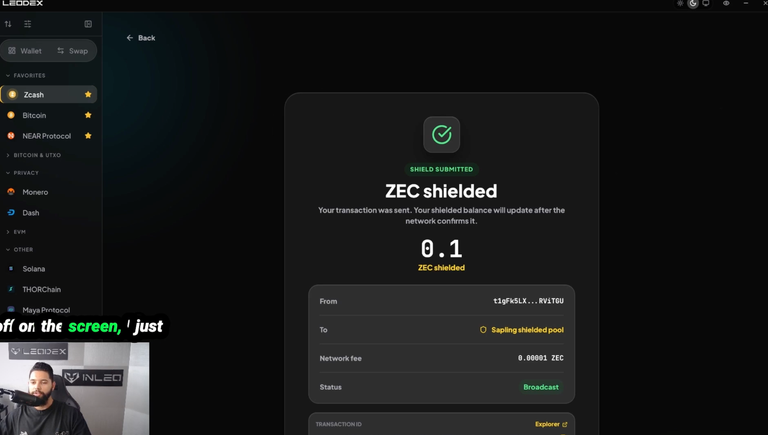
trust, but verify
This is the part most tutorials skip, and it's the part that matters if you want to actually check what just happened.
After shielding, click the Explorer link. LeoDex will open a Blockchair link of your transaction onchain so you can watch it confirm. You're not trusting LeoDex's UI — you're verifying that the network actually processed the shielded ZEC TX.
The transaction will show as pending, then confirmed within a few minutes or less. Once confirmed, the value lives in the shielded pool. Block explorers can see that shielding happened but when you start paying/swapping from that Shielded balance, it won't be connected to your T address whatsoever.
Pro Tip: don't shield an amount and then spend/swap that exact amount onchain afterwards as it creates a clear trail to your T Address
That's it. Your ZEC is now encrypted onchain. Welcome to encrypted Bitcoin.
The Shortcut: Skip Shielding Entirely with Direct-to-Shielded Swaps
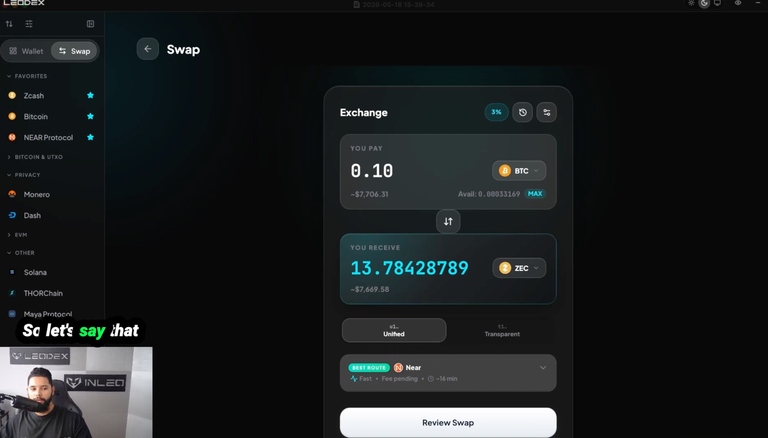
Here's the part of LeoDex that almost nobody is doing yet.
If you don't currently own ZEC and want some, the conventional path is:
- Buy ZEC on an exchange (lands in a transparent address)
- Withdraw to your wallet (still transparent)
- Shield it (the step above)
That's three transactions, two of which are publicly visible. Anyone scanning the chain can see you acquired ZEC, even if your eventual storage is shielded.
LeoDex supports direct-to-shielded swaps. You can put in 0.1 BTC, hit swap, and the ZEC arrives in your shielded balance. No transparent leg. No onchain record of the acquisition in your name. This is a UI flow that we've built seamlessly into the wallet. It is powered by our route providers at Near Intents and Maya Protocol.
The flow:
- Open LeoDex wallet
- Select the asset you want to swap from (BTC, ETH, USDC, anything supported)
- Select shielded ZEC as the output
- Hit Review Swap
- Confirm
The output lands shielded. You skip the shielding step entirely because there was never any transparent ZEC to shield in the first place.
Why I Built This Into LeoDex
Most privacy tooling in crypto forces you to pick: either run a dedicated app/node just for ZEC or accept that your shielding behavior is bolted into a single-purpose wallet you only open when you want privacy. Neither of those is how people actually live in a multi-chain world. They want to open one app and *"wonderfully manage their crypto assets". Securely, privately and entirely onchain and on their machine.
LeoDex's bet is: privacy should sit inside the same interface where you do everything else — crosschain swaps, trading, holding, paying. The act of shielding shouldn't feel like a separate ritual. It should feel like a natural part of navigating your crypto wallet.
The current numbers say the market agrees. ZEC has run from $380 to $615 in the last month, and the shielded supply keeps climbing. The thesis isn't "privacy coins go up." The thesis is that encryption stops being optional once AI makes surveillance free, and the assets that ship with it built in are the ones that get repriced.
Try It
If you want to actually do this — either shield existing ZEC or pick up some directly to a shielded address — open LeoDex and run through the steps above. The whole flow takes longer to read about than to just literally execute.
→ Try LeoDex: https://leodex.io
→ Try LeoDex's Wallet https://leodex.io/download (MacOS & Windows. IOS & Android coming soon)
Z cash is good but people said coti
would be better.
I am not sure i am investigate it.
@cryptoandcoffee is a big man of coti.
Congratulations @khaleelkazi! You have completed the following achievement on the Hive blockchain And have been rewarded with New badge(s)
Your next target is to reach 780000 upvotes.
You can view your badges on your board and compare yourself to others in the Ranking
If you no longer want to receive notifications, reply to this comment with the word
STOPwhen you can switch between btc or usdt to monero and vice versa, since monero solves that part of "separate privacy ritual", everything is unified in monero.
cuando se podra intercambiar entre btc o usdt a monero y biceversa, ya que monero soluciona esa parte de "ritual separado de privacidad", todo es unificado en monero
The UX improvements for Zcash shielding are real — it's gone from a multi-step headache to something that genuinely works in under a minute. But the adoption bottleneck for privacy coins has never been UX. It's liquidity and regulatory access. Most exchanges delisted Zcash or never listed it. Without a fiat onramp, even the best shielding UX doesn't matter for new users. Do you see a path where regulated onramps start supporting privacy coins again, or is the market permanently bifurcated into transparent and privacy chains?
Sorry sir for disturbing. Actually I am try to join discord inleo but I can't find inviting link??? Can you give me???
Privacy coins are a real usecase, especially in this AI age of times!! Lasse