Subscriptions That Bleed Your Wallet Dry

 This post stems from a question I raised some time ago in Queercoin, which I addressed in a post titled "HP's Legal Scams." In it, I denounced their corporate policy of blocking printer functionality via Wi-Fi if you didn't pay for a subscription plan.
However, I still had much more to say on the matter, as HP is not the only corporation scamming its customers with forced subscriptions that render equipment or software useless when fees aren't paid. The modern subscription model is the digital version of medieval serfdom: you pay for the right to farm a plot of land (your workflow) that will never be yours, and if you stop paying, the feudal lord keeps the entire harvest.
Currently, many companies have stopped selling products in favor of selling "access" that never truly becomes the user's property. This creates a dependency where the customer, upon stopping payment, loses access to their history, data, or acquired functionality.

This practice is closely tied to planned obsolescence, which previously consisted of manufacturing products that would physically break after a certain amount of time. Nowadays, the tactic is much more sophisticated and less visible: obsolescence through software updates and ecosystem locking. Through constant patches or changes to file formats (making them incompatible with older versions), they force you to update. If you don't subscribe, your old software becomes "useless" because it is no longer compatible with the rest of the digital world.
Companies have normalized the idea that you are not the owner of your tools, but a client renting them, and that what you create with them is yours only as long as you pay. This, in essence, is a kidnapping: "If you want to go back and edit work you created two years ago, you must pay the current monthly fee."
These corporate scams are now also being applied to durable consumer goods or software that does not require a constant connection (such as coffee makers that lock their grinding function if you don't pay, or basic productivity tools that used to be a one-time purchase). There are few international regulations in place to stop these extortionate corporate practices.
However, all is not lost. Open source software allows the community to maintain, fork, and continue using the tool if the original company disappears or becomes abusive. If you switch programs, you lose years of technical mastery and have to start from scratch; companies use this to lock you into their software. On the other hand, open source offers you the portability of your skills and guarantees that you own your tools, your files, and maintain total control over your workflow.
There are also "pirated" versions of current programs that allow you to continue working normally when you cannot afford the subscription (and I say this not as an incentive for piracy, but as part of the economic reality of the digital market). Furthermore, more accessible programs are being created for the public on Web3, so that we don't have to live in a perpetual state of updates and abusive subscription payments.
What do you think? Do you believe that, in the face of these extortionate corporate subscription policies, the public will move toward cheaper, less-known alternatives, or will these practices continue to thrive almost unchecked?
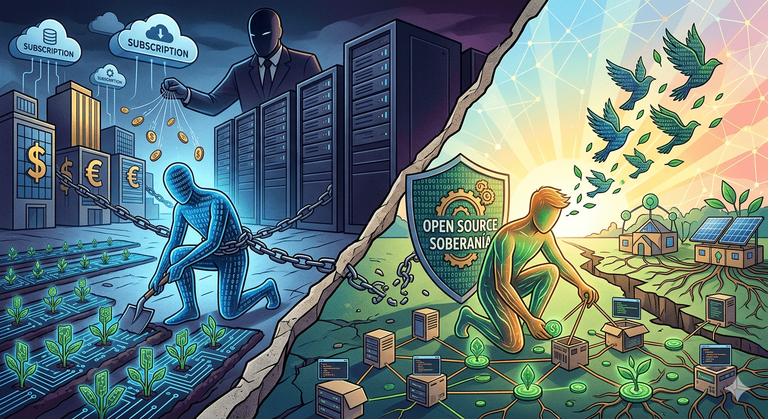
Note 1. Images created by gemini AI.
Note 2. English translation from Spanish by gemini AI.