Review of the book "Lord of the Flies" [Eng-Esp]

Greetings, community.
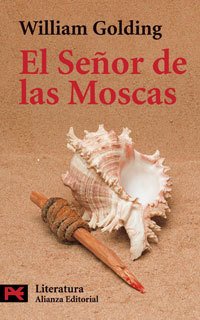
Back here to comment on the reading of the book "Lord of the Flies" by William Golding, an English writer and Nobel Prize in Literature winner, and how he, in my opinion, was not interested in telling a nice adventure story, but rather in digging into certain "uncomfortable" themes.
This novel presents a deceptively simple premise, where a group of British children are left alone on a desert island after a plane crash in which all the adults have died. The older ones try to establish order, assign tasks, build shelters, and keep a smoke signal burning, but soon a fracture appears that divides the story in two; it's not just a dispute over leadership between one character or another, it's like an ideological rift: on one side, the commitment to reason, rules, and hope of rescue; and on the other, the vertigo of hunting, painted bodies, and the scream launched into the darkness.
Golding breaks the veneer of civilization, which is thinner than we like to believe, viciously subverting that genre popularized by earlier novels—the one about clever boys who organize themselves in harmony; he keeps saying on every page that such a thing is a fairy tale.
Saludos comunidad.
De vuelta por acá para comentar la lectura del libro "El señor de las moscas", de William Golding, escritor inglés ganador del Nobel de Literatura, y de cómo este, a mi parecer, no estaba interesado en contar una aventura bonita, sino urgar en ciertos temas "incómodos".
Esta novela trae una propuesta que es engañosamente sencilla, donde un grupo de niños británicos quedan solos en una isla desierta tras un accidente aéreo, en el que todos los adultos han muerto. Los mayores intentan poner orden, repartir tareas, construir refugios y mantener encendida una señal de humo, pero muy pronto aparece una fractura que divide el relato en dos; no es solo una disputa por el liderazgo entre uno u otro personaje, es como una grieta ideológica: por un lado la apuesta por la razón, las normas y la esperanza del rescate; y al otro el vértigo de la caza, el cuerpo pintado y el grito lanzado en la oscuridad.
Golding rompe el barniz de la civilización, ese que es más delgado de lo que nos gusta creer, subvirtiendo con saña ese género que novelas anteriores habían popularizado, el de los muchachos ingeniosos que se organizan en armonía; él va diciendo en cada página que eso es un cuento.
There are children who slowly become dehumanized, and it doesn't happen when they stop tending the smoke signal, but when fear of "the beast" justifies any atrocity, when a pair of glasses—symbols of reason and science—stop being used for seeing and become spoils of war...
It is a tense novel, almost cinematic in its rhythm, but no less dense for that; it can be read almost in one sitting, as it is not a bulky volume of pages, though not light for that reason, but because you cannot put it down. It is like a dark fable, a warning about what human beings are capable of when social norms break down.
Those who dare to read it should not expect comforting morals, but rather an uncomfortable mirror, and perhaps by the end you will understand why Golding went far beyond a simple survival story; maybe he was writing about you, about me, about what remains when the lights go out.
Hay niños que se van deshumanizando lentamente, y no ocurre cuando dejan de cuidar la señal de humo, sino cuando el miedo a "la bestia" justifica cualquier atrocidad, cuando unas gafas —símbolo de la razón y la ciencia— dejan de servir para ver y pasan a ser un botín de guerra...
Es una novela tensa, casi cinematográfica en su ritmo, pero no por ello menos densa; se puede leer casi que de un tirón, pues no cuenta con un volumen abultado de páginas, aunque no por ello es ligera, sino porque no puedes soltarla. Es como una fábula negra, una advertencia de lo que es capaz el ser humano cuando se rompen las normas sociales.
Quienes se animen a leerla, no esperen moralejas reconfortantes, sino más bien un espejo incómodo, y quizás al terminar entiendan por qué Golding fue mucho más allá de la simple historia de supervivencia; a lo mejor estaba escribiendo sobre ti, sobre mí, sobre lo que queda cuando se apagan las luces.

Translated with Google (free version)
Traducido con Google (versión gratuita)
Gracias por su visita
Thank you for your visit
Posted Using INLEO
A concise and highly regarded critical review of this important novel, which marked a milestone in contemporary literature. Geeting, @david781211.
Gracias por el apoyo.
Saludos.
Esta publicación ha recibido el voto de Literatos, la comunidad de literatura en español en Hive y ha sido compartido en el blog de nuestra cuenta.
¿Quieres contribuir a engrandecer este proyecto? ¡Haz clic aquí y entérate cómo!
Gracias por su apoyo.
Saludos.