Humanoid robots harvesting tea in China

Humanoid robots harvesting tea in China
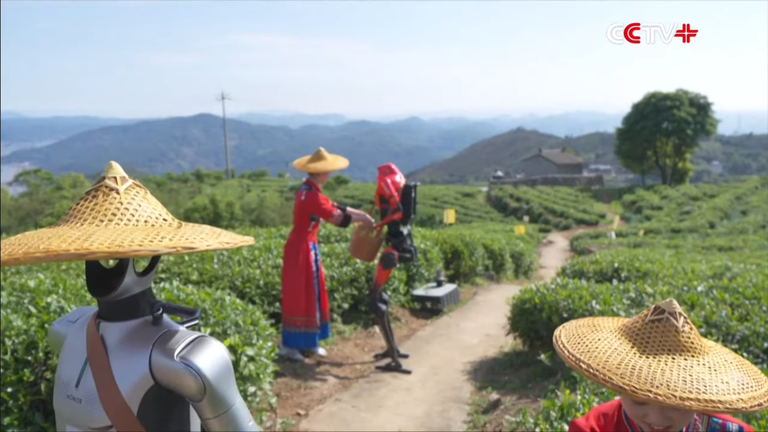



In April the humanoid Robots attracted attention running a half marathon in Beijing, it seemed more like an impressive demonstration of balance, locomotion and robotic coordination, but a few weeks later, China decided to take those humanoids to an environment much more difficult than a track prepared for public exhibition.


Taking them to the countryside, in the Chinese province of Fujian, G1 humanoid robots were placed to participate in an extremely delicate and traditional process, the artisanal production of tea, and harvesting, transporting, pressing and roasting tea leaves requires something that robots have historically always had difficulty reproducing. Fine adaptation to the real physical world. The humanoids underwent just a week of training before beginning to operate alongside human workers in real agricultural tasks.


And the objective was not only to show robots walking, it was to test whether artificial intelligence incorporated in mechanical bodies can begin to replace specialized manual work outside of controlled industrial environments. Perhaps the most important moment of the experiment occurred precisely in the torrefaction stage.


Traditionally master craftsmen control temperature, texture and point of tea almost intuitively, using experience accumulated over decades, the G1 attempted to reproduce this using real-time thermal monitoring, combined with advanced computer vision, in processing the robot observed invisible patterns of heat while continually adjusting the process, the test was not perfect, the engineers themselves recognized that robotic hands still face difficulties in extremely fine tasks.


At various times, the fingers of the G1 applied excessive pressure and ended up damaging some blades during handling. According to those responsible for the project, the movements of two robots were constantly monitored using motion capture and learning systems in the cloud, each failure generated new data to immediately optimize the control algorithms of the biomechanical hands, that is, the error of a single robot instantly feeds the learning of all the rest of us who are connected.


This creates an acceleration that is extremely difficult to compare with traditional human learning, a human craftsman takes decades to refine delicate movements, on the other hand, a network of robots can share improvements globally in a matter of hours and perhaps this is exactly why China is investing so much in these public tests linked to the 2026 Humanoid Robot World Games, because the goal no longer seems to be just technological entertainment, it is to replace human labor.


The shortage of humans for certain jobs is real, mainly among young people disinterested in extremely physically demanding agricultural and artisanal functions. So, for many companies, humanoid robots are beginning to appear not only as an innovation, but also as an economic necessity, and deep down, this entire revolution depends on something extremely strategic: chips capable of feeding the artificial intelligence behind these machines.


Sorry for my Ingles, it's not my main language. The images were taken from the sources used or were created with artificial intelligence


Posted Using INLEO


0
0
0.000
2 comments
avatar

Impresionante. En un futuro no muy lejano, creo que yosas esas labores agricolas y demas se haran por máquinas completamente. Saludos.

0
0
0.000
avatar

Thanks for your contribution to the STEMsocial community. Feel free to join us on discord to get to know the rest of us!

Please consider delegating to the @stemsocial account (85% of the curation rewards are returned).

Consider setting @stemsocial as a beneficiary of this post's rewards if you would like to support the community and contribute to its mission of promoting science and education on Hive. 
 

0
0
0.000